ArcelorMittal Belgium’s environmental performance is among the best in the European steel industry. Approximately 10% of our annual investment budget is allocated to environmental investments. Our approach has been rewarded several times with various awards and with the Voka Charter for Sustainable Business. We see this as recognition for our efforts and an incentive to continue the path we have chosen.
Dust control
Dust control is a top priority in our environmental policy. As a result of the many investments we have made, our dust emissions today are below 10% of the dust emissions of the early 1990s.
Our projects
A dust study, for which we commissioned VITO (2005-2006), demonstrated that diffuse emissions are particularly likely to affect the air quality in the environment of our site. In the last few years, we have therefore paid special attention to controlling this specific type of emissions. We bundled all improvement actions within a dust reduction plan running over several years, made interim adjustments, and supplemented the plan with new measures.
Some of our accomplishments:
- New harbor cranes with more effective sprinkler systems and wind screens.
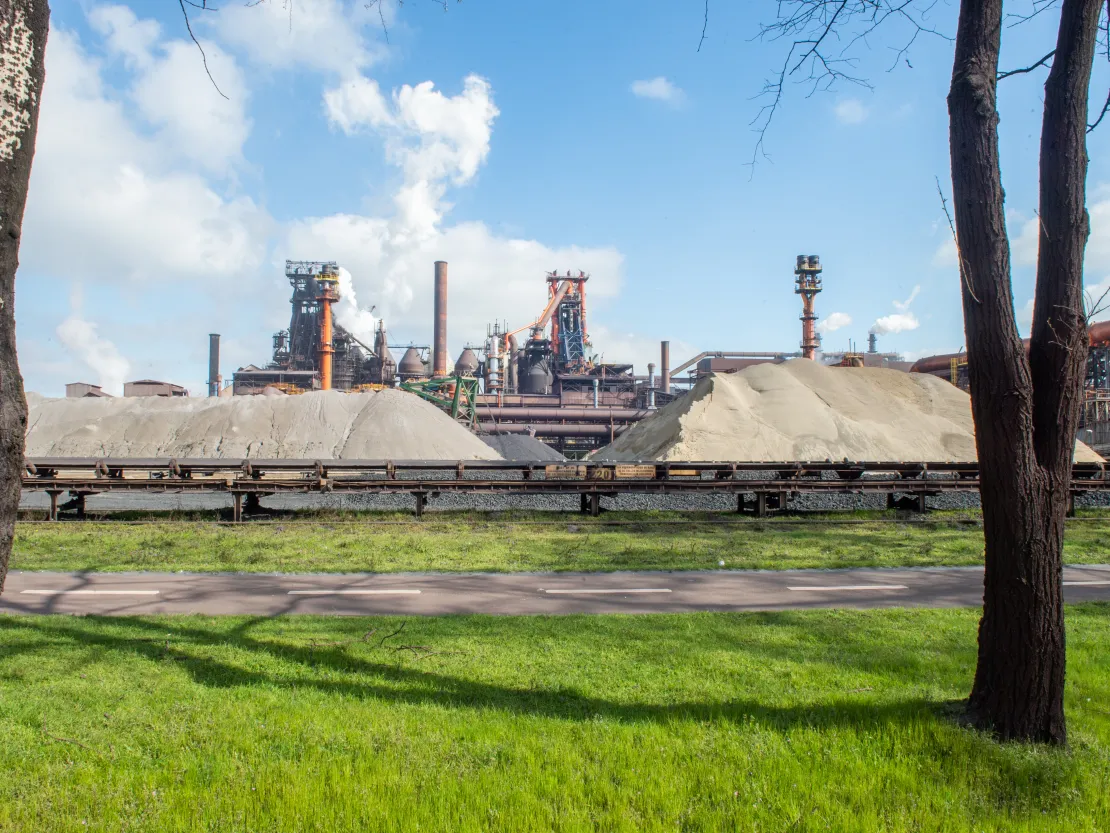
- The application of a coating (incrustator) on the piles of raw materials in dry and windy weather and placing dust barriers to prevent wind erosion.
- In 2017, we installed a sleeve filter system on the casting floor of blast furnace B (€11 million). We converted and expanded the dust filter systems in our sinter plants. A new hybrid filter was commissioned in sinter plant 1. At sinter plant 2, we commissioned a sleeve filter (totaling €21.5 million). These investments have led to a sharp reduction in regulated dust emissions since 2018, 75% of which come from the sinter plants.
- Construction of a 10 m high and 870 m long dust barrier/wind dike along the Ghent-Terneuzen canal to prevent wind erosion of the coal yards. The wind dike was completed in mid-2019. Construction of a second dust barrier/wind dike along the Kennedylaan to reduce dust emissions towards Sint-Kruis-Winkel in 2022.
- A thorough sweeping program to keep the roads within our site dust-free.
- An alert system in accordance with the weather conditions.
- Introduction of a color-coding system at the raw materials department to avoid dust emissions in adverse meteorological conditions (2020).
- We continued our efforts to improve air quality, including the installation of a waste gas recirculation system at the sinter plants, which were commissioned in mid-2021 (€13 million). Furthermore, in May 2022, a new hybrid filter (a combination of an electrostatic precipitator and a bag filter) was commissioned at the cooler of sinter plant 2 (€1 million). Thanks to these investments, the dust emissions from the sinter plant were reduced by half compared to previous years.
- We also invested in further dust abatement at the blast furnace area with a renewal of the stockhouse dedusting at blast furnace A (end of 2023) and a new dedusting stockhouse at blast furnace B planned for 2024.

Monitoring emissions
All other emissions, such as NOx, SOx, and dioxins, are carefully monitored through a comprehensive internal measurement program. This enables us to ensure the proper operation of our production and purification facilities and to make immediate adjustments when necessary. With regard to NOx and SO2 emissions, we also take proactive measures by carefully selecting raw materials with relatively low levels of nitrogen (N) and sulfur (S). The reason emissions have shown a downward trend in recent years (such as in 2023) is linked to the significant impact of the type of fuels we use in our sinter plants. Unfortunately, we are dependent on availability and market conditions, and due to the embargo on Russian products, we were and are unable to purchase fuels with low sulfur content.
Soil
November 2008
Blast furnace 6 at Seraing has been shut down.
12/2016
Blast furnace 6 at Seraing is demolished. The terrain will be cleared after which the soil decontamination will take place. The terrain will become part of an urbanization project of the city of Liège. The demolition and remediation are in line with the global agreement signed in February 2014 between the Walloon Region and ArcelorMittal. Phase 1, i.e., the soil decontamination of the undeveloped areas, has been completed.
Since 2018, soil studies for the implementation of phase 2 have been conducted.
The land is part of a large-scale redevelopment project in line with the city of Seraing’s master plan.
As part of the renewal of the Marchin environmental permit (HP5), a soil study was conducted. The results are generally favorable, but the groundwater requires monitoring.
As part of the adoption of the BREF FMP (a European Reference Document for Best Available Techniques for Ferro Metals Processing industries), a soil study will have to be carried out in 2023 & 2024 on the Ramet site. It will be submitted to the authorities in the second quarter of 2024.
As part of the renewal of the Kessales environmental permit, a soil study had to be carried out in 2023 & 2024.
Water
The steel production process requires enormous amounts of water, which is used as cooling water, as process water, and for environmental applications. As water is a natural resource, we use it with the utmost care.
The role of water in our production process
Cooling water
It is important to cool our facilities because our production process involves high temperatures. For example, we cool the motors of the sinter plants, the blast furnace shells, the converter in the steel shop, and the rolling stands of the hot strip mill.
Process water
Process water is used in our production process itself. This involves, for example, the water we use to extinguish coke, to granulate blast furnace slag into blast furnace sand, to remove the oxide scale from the steel slabs in the hot strip mill, as well as the water we convert into steam.
Environmental use
We also use water for dust control (for spraying unpaved roads in dry weather and in the sprinkling installations on harbor cranes when unloading dust-sensitive raw materials) and in the gas scrubbing installations of the blast furnaces and the steel shop.
ArcelorMittal Liège
The water used by ArcelorMittal Liège for the production process and for the cooling of its installations comes mainly from the Meuse and its tributary, the Hoyoux, as far as our Marchin production site is concerned. The water is purified after use and checked before it is
rejected to the Meuse or the Hoyoux.
As part of the authorization for the ‘La Chatqueue’ external landfill site in Seraing, the water collected will be rejected to the Cornillon stream. This process is continuously measured and the quality of the water at this stage is of such quality that no additional treatment is required.
Water treatment plants have been equipped with new instruments for measuring wastewater, which make it possible to increase reliability (calibration, maintenance, implementation). A new data backup system has also been put in place.


ArcelorMittal Gent
The main source of water for the Ghent site is the Ghent-Terneuzen canal. The canal water is pumped up to the north of the company grounds and goes in counter-current through the production process to ultimately be returned to the canal further south, after treatment in wastewater treatment plants, so that the applicable discharge standards are respected. Every cubic meter of water we pump up is reused about 25 times. Over the past two years, we have seen a decrease in the recycling rate. This is due to a general trend whereby less water can be recovered due to prolonged drought and the high conductivity of the Ghent-Terneuzen canal water over the last two years.
In the past, we also used groundwater for a few applications. Today, most groundwater is only pumped up for safety reasons. For example, in some places within our site, we must keep the groundwater level low, as contact with liquid hot metal from the blast furnaces or liquid steel from the steel shop could cause an explosion. In order not to lose this groundwater afterwards, we use it in a few quality-critical applications.
As such, in 2022, we did not extend the permit for artesian groundwater extraction since we no longer need it.
Due to the salinization of the canal water, which will increase after the opening of the new sea lock in Terneuzen in the fourth quarter of 2024, we will encounter problems with, among other things, the internal production of osmosis water (class B) in which conductivities will peak above 200 uS/cm (target class B is < 100 uS/cm).
That is why in the coming years we will invest heavily in seawater membranes (with high-pressure pumps) to replace the current brackish water membranes in the reverse osmosis plants, which is the only solution to keep up with the quality, knowing that during dry summers such as the one in 2022 the conductivity was around 14,000 uS/cm. With the commissioning of the new sea lock, it is expected to almost double.
Biodiversity
We conducted an in-depth biodiversity study in collaboration with a third party (ecological engineering firm) in 2023 for our site in Ghent. In this study, an extensive inventory of the fauna and flora was created via one to two site visits per month in the period from April to September. Specific search efforts were carried out for species groups such as birds, mammals, bats, amphibians, and various insect groups using wildlife cameras, bat detectors, and amphibian traps, among other things. After intensive research, no fewer than 553 plant and animal species were observed. General species richness is higher in the Rostijne sub-area (480 species) compared to the Arbed sub-area (296 species). The main reason for this is a greater variety of vegetation and site characteristics, with a greater proportion of dry and moist open vegetation types in the Rostijne sub-area. In contrast to the diversity of species, the high natural value of the site is mainly due to the presence of more mature and, at first sight, species-poor forest vegetation such as coniferous and poplar plantations.

A better understanding of the local biodiversity enables us to protect it and protected nature in our zone of influence as ArcelorMittal Belgium strives to diminish and prevent potential negative impacts on the biodiversity. Similar studies will be conducted for all ArcelorMittal Belgium sites.