
As a basic industry, the steel industry consumes large quantities of ores, fluxes, energy, and water. One of the key priorities of our environmental policy is therefore the efficient use of natural resources and energy. We are continuously investing in order to produce steel as sustainably as possible. In addition, we are doing everything we can to convert substances that are created during the process into useful products.
Our goal?
We aim to minimize waste as much as possible and give all residual flows a second life — either as raw materials for other industries or as alternative end products.
By-products
By-products are materials that are reused as raw materials or given an alternative use, such as blast furnace slag. We process blast furnace slag into blast furnace sand, a valuable raw material for the cement industry as an alternative to clinker.
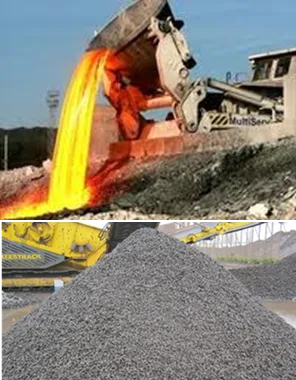
Slag from the steel shop, known as steel slag, is transformed into an artificial gravel, called LD gravel (a by-product of the Linz-Donawitz process). It is a durable and strong type of gravel that is used as a substitute for porphyry in road construction. Steel slag that is not suitable for LD gravel is used for paving roads, driveways, and even hydraulic engineering works such as the bank reinforcement of the Western Scheldt.
Residual gases
At the Ghent site, we produce 3 energy-rich gases: coke oven gas, blast furnace gas and converter gas. We recover and purify these gases and use them as fuel to replace natural gas.
Coke oven gas is consumed entirely internally after tar, benzene, and sulfur have been separated. These substances find their way into the chemical industry. We use some of the blast furnace gas and converter gas ourselves; the remainder is converted into electricity at the nearby Engie power plant.
Residues
Residual materials such as sludge containing iron oxide or carbon are generated during our production process. We remove these in dust separation or water treatment installations and reuse them as much as possible, in full compliance with technical requirements and environmental standards.
By reusing these substances:
- we save on expensive raw materials such as iron ore and coal,
- we use natural resources more efficiently,
- we prevent the disposal of material in landfills.
Scrap generated internally, for example when cutting steel coils to size, is also recycled in our steel shop. Residual materials that we cannot use internally are given a useful application in other sectors.
Waste materials
For materials that cannot be reused, we ensure they are selectively collected and disposed of through certified processors. This includes clean waste wood, PMD (plastic, metal, and drink cartons), and small hazardous waste.
Chatqueue (Bois de Cornillon)
Chatqueue’s Technical Landfill Center (C.E.T.) in Seraing processes the small amount of non-recyclable residual waste left over from steel production. The site is managed in accordance with strict environmental regulations and is part of a sustainable environmental policy. You can find more information about the site’s activities and environmental performance in the environmental statement.
Circularity in practice

The coking plant
Our coking plant is a prime example of circular operations. Besides coke, we extract tar, sulfur, and benzol from the raw coke oven gas. The purified gas serves as an energy source for the ovens; the remainder is used elsewhere on the site. Other residual streams are also recycled internally as much as possible. A great example of reuse!
A second life for carbon
A great example of carbon reuse is illustrated by the Torero project, which converts waste wood into biocoal, and Steelanol, the facility that transforms steel gases into ethanol.
